Lions Football SVG Cut File
First Impressions: Bold, Playful, and Ready for Stitching
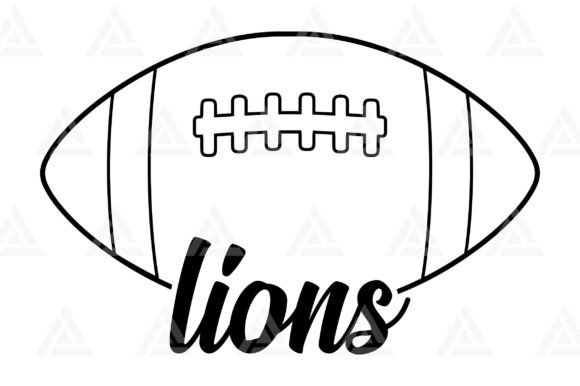
Opening Lions Football Svg Cut File feels like unboxing a spirited team mascot—energetic, confident, and instantly recognizable. The vector layout is clean and centered, with strong silhouettes and balanced negative space. It’s not overly detailed, which is a quiet win: this isn’t a photorealistic portrait—it’s a graphic emblem built for impact at medium to large sizes. As an embroidery designer who regularly translates digital files into stitched reality, I immediately saw its potential on a custom embroidered tote bag for a local youth football league fundraiser. That’s where it lives best—not as a tiny chest logo, but as a statement piece on the front of a sweatshirt, the center of a kitchen towel, or the focal point of a nursery wall hanging.
Where This Design Shines in Real Embroidery Projects
Lions Football Svg Cut File thrives in projects that prioritize clarity over complexity. On a heavyweight cotton sweatshirt? Excellent. The bold lines translate cleanly into satin stitch borders and dense fill stitch bodies—no bleeding, no thread nesting, assuming proper stabilizer use. For baby embroidery—think onesies or burp cloths—it holds up well when simplified to two or three thread colors, especially if you reduce internal detail slightly before digitizing. As a patch design, it stitches crisply with clean edges, making it ideal for scout groups, school spirit events, or boutique-branded aprons.
I tested a scaled-down version (about 3.5” wide) on a tea towel using a mid-weight tear-away stabilizer—and it held its shape beautifully after washing. That’s a real-world signal: this isn’t just a “cut file” for decals or stencils; it’s structurally sound enough to become a durable machine embroidery design, provided you treat it like one—not as a flat vector, but as a stitch plan.
Use With Care: Fabric, Scale, and Context
This design doesn’t love every surface. On thin, stretchy fabric like lightweight jersey or baby knit, the outer contours can pucker unless you add cutaway stabilizer *and* reduce stitch density slightly in the fill areas. Curved surfaces—like caps or structured hats—require careful hooping and possibly splitting the design across two hoops if the lion’s face spans too much contour. Tiny corners (say, the tip of an ear or claw) may need manual cleanup in your embroidery software to avoid skipped stitches or thread breaks.
It also demands thoughtful color pairing. Because Lions Football Svg Cut File relies on strong shape contrast rather than fine linework, low-contrast thread choices (e.g., light gold on cream) risk looking washed out—especially on dark fabric. Always test in black and white mockups first. And if you’re planning layered garments (like a reversible tote), remember: dense fill areas won’t drape softly. That’s fine for a holiday embroidery gift—but less ideal for a delicate pillow cover meant for daily use.
What It Adds to Your Finished Product—Beyond Just Looks
There’s a subtle but meaningful lift in perceived value when customers see a cohesive, confident emblem like this on handmade product. A customer buying a personalized gift isn’t just paying for stitching—they’re buying team pride, childhood nostalgia, or local connection. Lions Football Svg Cut File delivers that emotional resonance without visual clutter. It reads clearly from across a room, supports brand consistency for small shop product lines, and scales gracefully across formats: from a simple running stitch outline on a linen napkin to a full-color applique design on a denim jacket.
For Etsy sellers and craft fair vendors, it’s a reliable anchor design—versatile enough to pair with seasonal fonts or monograms, yet distinct enough to stand alone. It doesn’t scream “generic sports clipart.” It feels intentional, warm, and hand-crafted—even before a single needle drops.
Practical Designer Notes Before You Stitch
- Always test on scrap fabric first—especially if you’re using textured fabric or blending thread colors.
- Review stitch density before finalizing. Dense fills look sharp but increase wear on machines and stabilizer consumption.
- Confirm hoop size compatibility. If your machine’s max hoop is 4x4”, check whether the full design fits—or if you’ll need to resize or split it.
- Inspect small details in your embroidery software: tight curves, intersecting lines, and inner negative space often need smoothing for clean satin stitch transitions.
- Use proper stabilizer—mid-weight cutaway for knits, tear-away for stable wovens, and fusible + tear-away for lightweight linens.
- Check licensing terms before selling finished items or bundling the file as part of a digital embroidery file pack. Since this is categorized under Graphics and Crafts, commercial use isn’t automatic—verify before listing on Etsy or offering as a craft business asset.
- Compare light and dark fabric backgrounds in printable mockups. What works on white cotton may vanish on navy fleece without adjusted thread brightness or underlay.
Final Thought: A Solid, Flexible Asset—Not a Magic Button
Lions Football Svg Cut File isn’t flashy, and it shouldn’t be. It’s the kind of design that earns trust—not through novelty, but through reliability. It performs consistently across custom apparel, embroidered patch production, holiday embroidery runs, and small-batch boutique branding. It respects the limits of thread, fabric, and machine—and rewards thoughtful execution with professional-looking results. Whether you're a seasoned embroidery project manager or a hobbyist launching your first Etsy shop, this file earns its place in your design assets library. Just remember: even the strongest SVG needs your judgment, your stabilizer, and your eye for what stitches truly well.